Banished from Southern Mississippi, Lardarius Webb landed at a small school in the bayous of south Louisiana, regretting his blown opportunity at college football’s highest level and the lousy example he’d set for his young son.
“I don’t want to raise him trying to tell him what’s right and wrong if I didn’t do right,” Webb said of Lardarius Jr., who’s now 6 and lives with his mother in Alabama. “He’s my No. 1 fan. He really looks up to me, so I just want to show him the right way of living.”
The 23-year-old Webb could become a role model for countless more if his name is called, as expected, during this weekend’s NFL draft.
After two seasons at Nicholls State, Webb’s resume shows he’s the first player in NCAA history to win a conference’s defensive, offensive and special teams player of the week honors in the same season. He also is a two-time All-America selection at safety in the Football Championship Subdivision.
“He got a second opportunity with us and—heck, man—he took it and ran with it,” said Nicholls coach Jay Thomas, who gave Webb his second chance after Southern Miss dismissed him for violating team rules.Webb even gained coaching experience, volunteering to oversee Nicholls’ defensive backs when a temporary hiring freeze at the school—due to the recession’s effect on the state budget—left Thomas short-staffed for recent spring practices.
“I knew the defensive backs needed some help,” Webb said. “Not that I’m the best coach ever, but I do have things I could tell them about—everything I’ve been through to get where I’m at now. … It was a good opportunity— something I can put on my resume.”
Webb said scouts told him he could be drafted between the second and fourth rounds. Although he played safety at Nicholls, he expects to be drafted as a cornerback. His 4.46 in the 40-yard dash tied for the top time among cornerbacks at the NFL’s scouting combine last February.
Last week, he was in New York to meet with the Giants. His other NFL visits included Baltimore, Tennessee and Tampa Bay.
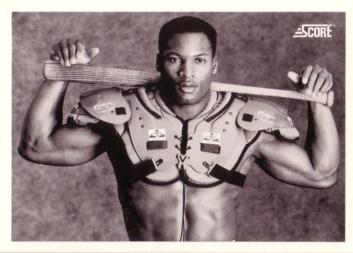
On Tuesday, the legendary two-sport athlete was among a group of investors that cut the ribbons on The Burr Ridge Bank and Trust in the Chicago suburbs where Bo lives. He's on the bank's board of directors and is said to be "rolling up his sleeves" and working among everyone else to make sure the small bank becomes a success during tough financial times.
This isn't Bo Jackson's first foray into business. He owns the Bo Jackson Elite Sports complex in Lockport, Ill, with former big league outfielder John Cangelosi and has been successful with other investments, like his food company, N'Genuity. (Bo's also a gourmet chef.) He often speaks that while he may have been great for sports, sports were no doubt greater for him considering the post-career opportunities that have been afforded to him.
Since his retirement, Jackson has a led a family-driven life in the Chicago suburbs, but the public's fascination with him continues. Two years ago, he was the subject of two excellent profiles — one by Michael Weinreb and the other by Joe Posnanski — that landed in the same edition of Best American Sports Writing.
Time will tell if Bo's foray into community finances is successful — in the CBS interview he tells a story about being a certified teller during college and coming up $16,000 in his cash drawer short one day — but hopefully he'll have a little more compassion for his customers than the most famous — albeit fictitious — local banker in history.
Former Chicago Bears defensive lineman William “The Refrigerator” Perry remains hospitalized in South Carolina.
Aiken Regional Medical Center spokeswoman Melissa Summer said Wednesday that Perry is in serious condition. The 46-year-old Perry has been hospitalized to deal with complications from Guillain-Barre (gee-LAN’ bah-RAY’) Syndrome, a chronic inflammation disorder of the peripheral nerves.
Perry’s nephew, Purnell Perry, said Tuesday that his uncle was admitted more than a week ago but was expected to recover. A man who answered the phone Wednesday at Purnell Perry’s home in Aiken said he couldn’t comment on the football player’s hospitalization. The 300-pound plus defensive tackle played for the Bears’ 1985 Super Bowl team, and helped lead Clemson to the 1981 national championship.
How could he not be great in the NFL? How could Tony Mandarich possibly be a bust? I saw what might have been in 1988. I was an 18-year-old freshman defensive end at Rutgers. At that point, the Rutgers football slogan was "On the Rise" because we were always mediocre in those days. Our first game that season was against Michigan State, the 15th-ranked team in the country and defending Rose Bowl champ. They had an All-America tackle -- Tony Mandarich -- who was humiliating players every week.
He was 6-foot-6, 320 pounds. He was huge. He was a mutant. He was all-natural? Impossible. I was all-natural, tipping the scales at about 230 and having already lost about 10 precious pounds in training camp. Not a great matchup. You can imagine how that would have turned out. But it never happened. I was redshirted and wasn't going to see the field unless the seven or eight players in front of me were maimed.
And Mandarich, ultimately, was suspended. He sat out the first three games of the season after applying for the NFL draft. During training camp, we studied Michigan State's offensive line on film. Watching the Rose Bowl, we saw Mandarich pancaking Tim Ryan from USC on one play, driving him out of the film frame on the next. It wasn't as if Ryan was terrible; the guy was a first-round pick of the Bears a year later. Our reaction? Laughter. Not because Ryan was getting destroyed, but because we weren't. That wasn't going to be us because he wasn't playing.
We watched more film, and it wasn't only Ryan. We saw an All-America defensive end pinned to the ground by Mandarich, a linebacker from Wisconsin on skates 10 yards downfield, a defensive tackle from Ohio State curled up in the fetal position. The worst was the Iowa team captain who went for the trifecta: on skates for 10 yards, pinned to the ground and then curled up in the fetal position. It didn't stop there. Mandarich punched an Ohio State player during the coin toss and told him he "was going to die today." He drove a Northwestern player into the end zone, pancaked him and then told the player to "stay there."
Sometimes he was blocking two players at a time. Who does that? It was a no-brainer that Mandarich was the most dominant college offensive lineman ever. Maybe not the best, but definitely the most dominant. How could he not make it in the NFL?
The Unnatural
Well, for starters, he was cheating. He was chemically enhanced to the nth degree. He was the Six Million Dollar Man of steroids. "I was taking Winstrol V, equipoise, Anadrol 50s, testosterone, Anavar, Dianabol," he told me dispassionately in an ESPN interview last month at the W Hotel, near his home in Scottsdale, Ariz. Twenty years after he was the second player taken in the 1989 NFL draft, Mandarich is 42 years old. He looks like a cross between Judas Priest's Rob Halford and "Stone Cold" Steve Austin. He's still huge and looks as if he could still play. He told me he had been taking steroids since May 1984.
His older brother, John, who was playing at Kent State, turned Mandarich onto them. His usage escalated during his time at Michigan State. The rumors of steroids started to surface, but schools were not testing for steroids yet, and the NCAA tested only at bowl games. Mandarich kept beating the system. He cheated on the tests for the Rose and Gator bowls. "I basically strapped something to my back a little -- it was actually a little doggie toy," Mandarich said in an interview that stretched longer than 2½ hours. "Hooked up a little hose to it … ran a tube underneath and put a piece of gum to cap the tube." As a player, his legend was growing. So was his ego.
"You're not supposed to be as strong as I am. You're not supposed to be as fast as I am. You're not supposed to be as good as I am," Mandarich said in the midst of his steroid haze in 1989. He dropped out of Michigan State after the Gator Bowl and moved to Los Angeles. It was where he wanted to be -- a big city with big-city media. He had big plans. He wanted to play football for six or seven years in the NFL, win Mr. Universe and then move on to the movies. He wanted to be the next Arnold Schwarzenegger. He was hanging out with Guns N' Roses, and he had the tattoos to prove it.
All the while, against the general rules of nature, Tony kept getting bigger, stronger and faster. He hosted his own combine at Michigan State that spring. The numbers were staggering:
The hype machine was at full throttle. Sports Illustrated, memorably, put him on the cover, shirtless and massive. It called him "the best offensive line prospect ever." It bragged of his insane 15,000-calorie diet and his love for Axl Rose. I put that SI cover on my dorm wall. Every lineman -- high school or college -- probably did the same. He was what all of us aspired to be: huge, cut and nasty on the football field. He was supposed to change offensive linemen forever. He was the anti-Reggie White, the guy who was built to block men like White and maybe even dominate them.
As the 1989 draft approached, Mandarich was the highest-rated player on the board. Higher than Troy Aikman. Higher than Barry Sanders. Higher than Deion Sanders and Derrick Thomas. It was on. He had serious clout. Mandarich could call his own shot. Everyone had bought in. Almost everyone. The Kansas City Chiefs were courting Mandarich because they had one of the top five picks in the draft. General manager Carl Peterson and coach Marty Schottenheimer took him out to dinner. They asked him whether he was on steroids, Mandarich says. Fair question. Mandarich said he had never failed a drug test. Not exactly what the coach wanted to hear.
According to Mandarich, Schottenheimer looked him square in the eye and said, "I think you're lying." "If you think I am lying," Mandarich said coolly, "then don't draft me." His arrogance with NFL teams did not stop there. "I had said even before the draft that I did not want to get drafted by the Packers," Mandarich said. "I didn't want to play in a small market. I called Green Bay a village. Some of the stuff I said, when I look back now, is just embarrassing."
Saying it, he truly sounds embarrassed, maybe even disgusted. Needless to say, the Packers took Mandarich second overall, after the Cowboys took Aikman. Some experts thought Dallas was crazy for not taking Mandarich. The Packers weren't planning to pay him the $1.1 million per year that he was demanding. So, Mandarich cranked up the hype again. He held out of Packers camp. Then he appeared on "Late Night with David Letterman." Mandarich: "I want to fight Tyson." Letterman: "Oh, geez … what kind of a guy does it take to sit here and say that?" The Packers might lose Mandarich to boxing? They had to ante up. And they did.
A mythical monster
Green Bay had no idea what it was getting for its $4.4 million; Mandarich was the first offensive lineman to make seven figures a season. Mandarich missed the entire training camp. He wasn't ready to play in the NFL's pass-first game. Michigan State threw the ball maybe 10 times a game in those days, and pass blocking was not Mandarich's strong suit.
But something else was happening, and it wasn't just steroids. Mandarich had stopped taking steroids just before the combine for fear of getting caught by the NFL drug-testers. Those guys actually watch you fill the cup from point-blank range. No dog toys to save him there.
The bigger issue, according to Mandarich, was an addiction to painkillers. He was a junkie. By the time he arrived in Green Bay, he was hooked. As he ended his steroid usage, he started taking painkillers to get rid of the aches and pains from his intense weight training. He wasn't messing around, either. He was main-lining them. Straight into the vein. Six or seven times a day. Even during practice.
"I was getting really paranoid about people finding out, so what I would do with that bottle and a syringe, I would put it in my jock strap," Mandarich said. "I'd say 'Hey, I've got to go to the bathroom,' lock myself in the bathroom, take a shot, and then come back out to practice and get ready for one-on-one pass drills with the defensive line, and I'm half in the bag." He did this every day. Stadol, Fiorinal #3, Valium, Percodan, Percocet, Vicodin. The shots eventually became pills because they were easier to come by, and sometimes the pills were replaced by booze.
Mandarich created a monster built on lies. It was all torn down in a few months. He was the bust to end all busts. He never got on the field for the last year of his contract, 1992, and Mike Holmgren's new Green Bay regime elected to not re-sign him. "I spent four years in Green Bay and never [had] a sober day," Mandarich said. "Every day I was ever in Green Bay I was not sober." Mandarich went to his home in Traverse City, Mich., and became a full-time junkie -- and hid. His full-time job was to find ways to get more drugs by conning another doctor or faking another illness.
More lies. Things got worse. Mandarich's older brother, John, was dying of cancer. John was his hero, having played for Kent State and then the Edmonton Eskimos in the Canadian Football League. On the day John died in 1993, his little brother was in his truck, driving 400 miles to Green Bay from Traverse City to get more painkillers.
At that point, the drugs were more important to him than anything. This was the time that Mandarich was supposed be in the prime of his career, taking on Reggie White and Bruce Smith on his way to the Hall of Fame, with yearly visits to Hawaii along the way. Instead, he was chasing down painkillers to get by until the next day. He was down to 260 pounds, pale, and looking nothing like the shirtless guy who was on the cover of SI.
"Fifty, 60, 70 painkillers a day," Mandarich said. "I would just drink more because it's easier to get alcohol. A lot of self-loathing … absolutely hated myself. I hated everything about me." He could never live up to that monster he created.
Making it right
Rock bottom. He was there. In March 1995, Mandarich checked himself into the Brighton Hospital Chemical Dependency and Mental Health Treatment Center in Brighton, Mich. Twelve steps. Time to pay the price for all those lies.
"How in the world do you make amends for the disaster you created in the NFL?" he said, sounding contrite. "And that you had wronged the fans, you had wronged the Packers, you embarrassed the sport. How do you right that wrong?" Mandarich's way was to try to come back to the NFL, but this time do it right. Clean. Sober. No outrageous comments. Be happy to be there.
Miraculously, Mandarich made it back to the NFL in 1996, playing for the Indianapolis Colts. He was huge once again, weighing in at around 320. But this time, he says, it was natural. No juice. For three more years, he was good, not great -- not pinning guys on their backs, not keeping stats of pancakes and guys he drove off the screen.
But he says he was clean. And Mandarich insists he has remained clean since. Today he keeps a low profile in Arizona, with his wife and business partner, Char. They run an Internet marketing company and do photography and video work. In their home, there are few mementos from his football days. In one small room, his Michigan State Rose Bowl jersey and his Colts jersey hang on the wall. Nothing from his years with the Packers. No other trophies. A few years ago, Mandarich took all the trophies he had from Michigan State and burned them.
"Got tired of them sitting in boxes," he explained. That might have been as symbolic as anything he did. Clearly, that time in his life is well behind him. He is promoting a new book, "My Dirty Little Secrets," published by Modern History Press. He said he wants to speak to NFL players about the dangers of steroid abuse and painkillers, another step in the 12-step circle of making amends.
He has become -- sincerely, it seems -- reflective. "I don't regret any of the pills I took, or I don't regret the steroids I took," he said. "I don't regret the whiskey I drank, and I don't regret the mistakes I made, because all of those things coupled together tore me down and made me forced me to look at myself and forced me to make corrections -- it was either make corrections or die for me." There is one eye-catching remnant of his chemically enhanced life. The infamous Sports Illustrated cover, the one that proclaimed him "The Incredible Bulk." He has a blown-up version in his garage. It hangs just above a garbage can.
He's on track to earn his master's in public administration this December and is already working to start his own charitable foundation for underprivileged children. He envisions a Make-A-Wish type organization where kids who show promise and responsibility get to live out their sports dreams, which will hopefully in turn inspire their peers to pursue the right paths.
"I hope it turns into something national," Gunn said. "I'm in a position in my life now where I can impact lives, and I want to take advantage of that."
Gunn nearly was forced to begin his life after athletics early. The Pittsburgh linebacker suffered a broken neck in a freak collision with teammate Scott McKillop in the first game of his senior season last fall. He missed the entire year and, since he had already used a redshirt year, figured his playing days were over.
But in March, Gunn was granted a rare sixth year of eligibility from the NCAA. Though he won't be cleared medically for full tackling drills until July, Gunn went through most of spring practice for the Panthers while playing middle linebacker. He will go into the summer as the starter at the spot where McKillop won defensive player of the year honors in 2008.
"That's the one position where I think leadership and experience probably has more of an influence than playing on the outside," head coach Dave Wannstedt said about moving Gunn from strongside linebacker to the middle. "He's handling it extremely well."
Gunn said he was a little nervous the first couple of practices this spring, but then he resumed playing like normal. Perhaps it helps that he has no memory of the helmet-to-helmet collision with McKillop as both went to level a hit on a Bowling Green receiver. Gunn was rendered unconscious on the play and said he has only watched it once on tape.
"I'm kind of trying to forget about it," he said. "I don't want to be out on the football field and maybe have a flashback right when I'm going to make a tackle."
Doctors initially didn't think Gunn had incurred serious damage, but later X-rays showed that he had a broken neck. He underwent surgery to fuse the fourth and fifth vertebrae of his cervical spine with a titanium plate, held in place by four screws.
Gunn's older brother, Sanford, suffered the same injury during his senior season at Indiana University of Pennsylvania and was temporarily paralyzed for several days. He did not play football again.
"I couldn't believe it happened a second time," said Gunn's mother, Dona Wingo. "We found out that it's a hereditary problem."
Gunn said he has been reassured by doctors that there is no risk of further damage by playing. He's been told that his spine is actually stronger now than it was because the two vertebrae are fused into one. Other than the protective collar he's always worn, he's not going to do anything differently to try and prevent another injury.
This is a true man that loves the game of football and has a great look on life and wants to make get things happen for other children and people too. It is very touching to see guys like this in our world and also as a football player in the sports community.
Jack Elway, son of Pro Football Hall of Fame quarterback John Elway, has decided to leave the Arizona State football team.
Elway, a redshirt freshman quarterback, will remain at Arizona State as a student, however.
"He's just tired of football and wants to do something else with his life," Sun Devils coach Dennis Erickson said Monday, according to The Arizona Republic. "He made a decision, and we all understand it. He would have played here eventually."
Elway, who was in a five-way battle for the starting quarterback job this fall, was considered to be behind senior Danny Sullivan and redshirt sophomore Samson Szakacsy on the depth chart, with sophomore Chasen Stangel and freshman Brock Osweiler also in the mix. Elway did not play in a scrimmage last weekend.
Life decisions and football decisions blend together. Everything always traces back to the game.Maresh epitomizes the eat-sleep-breathe cliché. He's described by those who know him best as born to play football. And given what he's been through to play linebacker at Minnesota, it's hard to argue with them. Faced with the daunting reality of open heart surgery in June 2008, Maresh made a choice with football very much in mind. When doctors discovered a benign mass in his leg in February, Maresh stiff-armed talk of surgery and readied himself for the start of Minnesota's spring drills. "If football or sports was a hobby, you'd be looking at it differently," said Maresh's father, Bill. "But it's part of his life. It's part of who he is. He's a physical, fighter-type guy. There was never a decision that was hard. If there was a way that he could play, he was going to take that opportunity. And it's worked out." On the afternoon of March 24, Maresh, wearing a white No. 17 practice jersey, jogged onto the field with his Gophers teammates for the start of spring ball. He did so with a scar on his chest, a growth in his leg and a look of resolve in his eyes. Less than nine months after heart valve replacement surgery, Maresh was back, just as he had planned. "It wasn't a question at all," Maresh said. "I'm playing football. It's what I was born to do."But this is about more than football. A lot more. Maresh is attempting to make medical history this fall. Other athletes with his heart condition have returned to compete, including NBA players Ronny Turiaf and Etan Thomas. But no one has returned to play top-level college football. "We've had a number of athletes that have had this kind of problem that have gone back to playing baseball and basketball," heart surgeon Dr. Hartzell Schaff said. "I don't remember anybody who's gone back to playing football like he's playing."Gophers coach Tim Brewster branded Maresh the "flag bearer" for the university when the heralded recruit signed in 2008. But Maresh transcends that role. He has become a symbol for the state, a courageous figure who has received support from Duluth to Mankato, International Falls to Rochester. Indeed, football is only part of Maresh's story.
I am a college student at Marietta College and I am a Broadcasting Major with a AD/PR Minor. I loves sports and football more than others. I am not a huge fan of writing print or papers but i do love to blog and speak my mind on topics that interest me and football and sports is one of them.

 Banished from Southern Mississippi, Lardarius Webb landed at a small school in the bayous of south Louisiana, regretting his blown opportunity at college football’s highest level and the lousy example he’d set for his young son.